
Gorillas, Chimpanzees, Golden Monkeys: an honest review of our primate safari in Uganda and Rwanda
This blog series consists of 4 parts:
- Part 1 is about our first encounters with the Great Apes of East Africa during our two Chimpanzee treks in Kibale National Park and Kyambura Gorge
- Part 2 covers the differences and similarities between Gorilla trekking in Uganda and Rwanda
- Part 3 reflects on the difference between chimpanzee and gorilla trekking, as well as the wider conservation context of the protection of these great apes through tourism. A short bonus chapter details my review of our Golden Monkey trek in Mgahinga in Uganda.
- Part 4 contains my review of our entire itinerary with Volcanoes Safaris, including our many other conservation and community experiences. It details what it is like traveling with Volcanoes Safaris, meeting their team and our thoughts about the five lodges we stayed at.
-
How do I even start explaining the whirlwind of a safari we have just been on? As I’m waiting at Johannesburg Airport to board the airplane home to Kruger Park, I’m processing all that I’ve just experienced over the past 10 days.
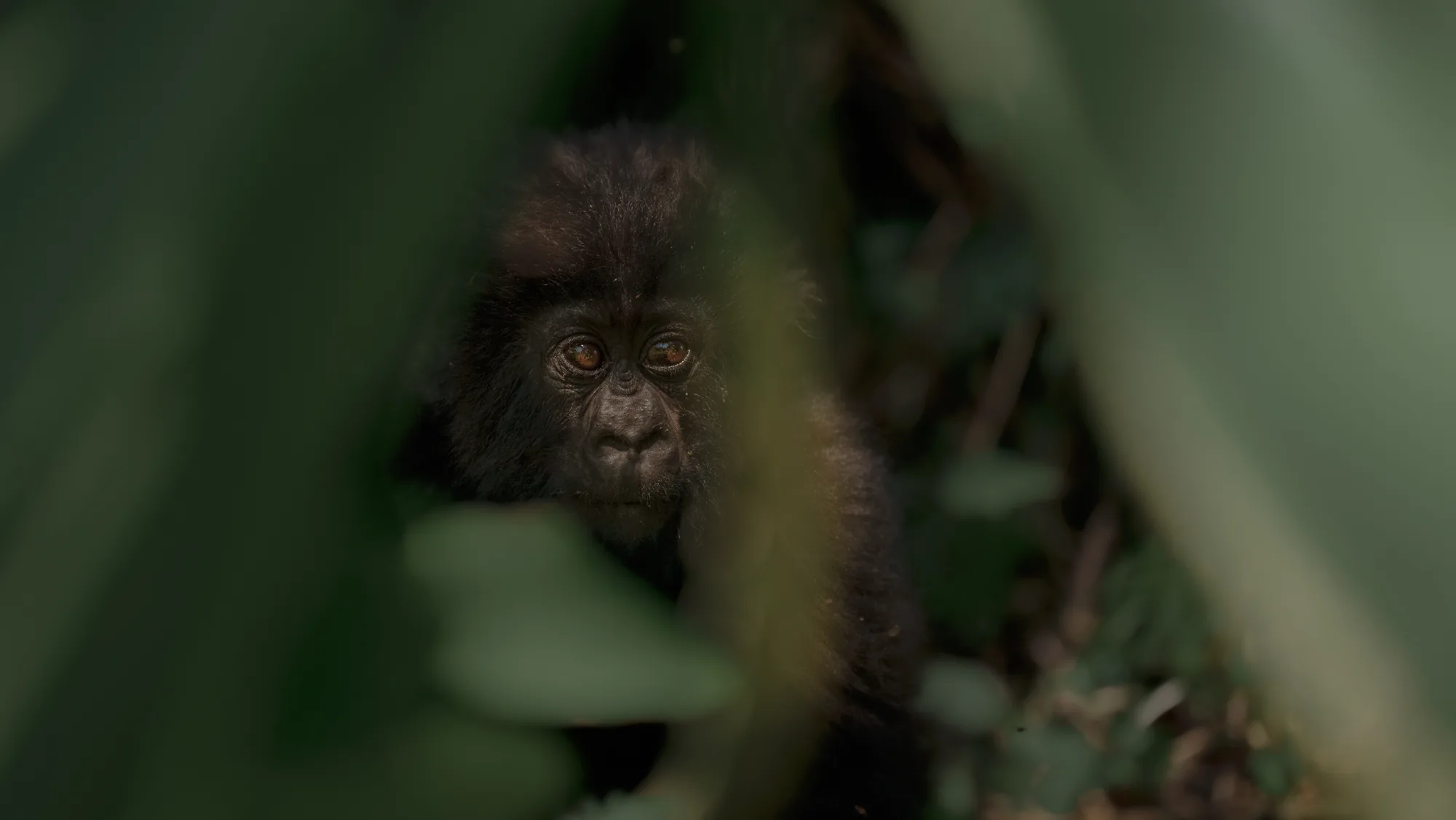
Five primate treks in ten days: coming face-to-face with East Africa’s most endangered primate species
In part 1 (chimpanzees) and 2 (gorillas) of this series, I focussed on what it is like to come face-to-face with some of Africa’s most endangered Great Apes. The stories of our treks, memorable moments and some reflections of the difference between the habitats we explored and the primate species we met.
This part 3 reflects on the delicate and ever-present balance and tension between the survival of wildlife and the people they share their mountainous homes with. It also details the differences between trekking chimpanzees versus gorillas, based on my personal experience from four different treks: two chimpanzee and one gorilla trek in Uganda, and one gorilla trek in Rwanda.
A short bonus chapter at the end of this blog details our Golden Monkey trek: an encounter that turned out to be much more challenging than expected!
For this trip, Nini and I traveled with Volcanoes Safaris, together with 6 other travel agents. For a detailed review of what it is like traveling with Volcanoes Safaris, meeting their team and to learn our thoughts about the five lodges we stayed at, read our Volcanoes Safaris review here.
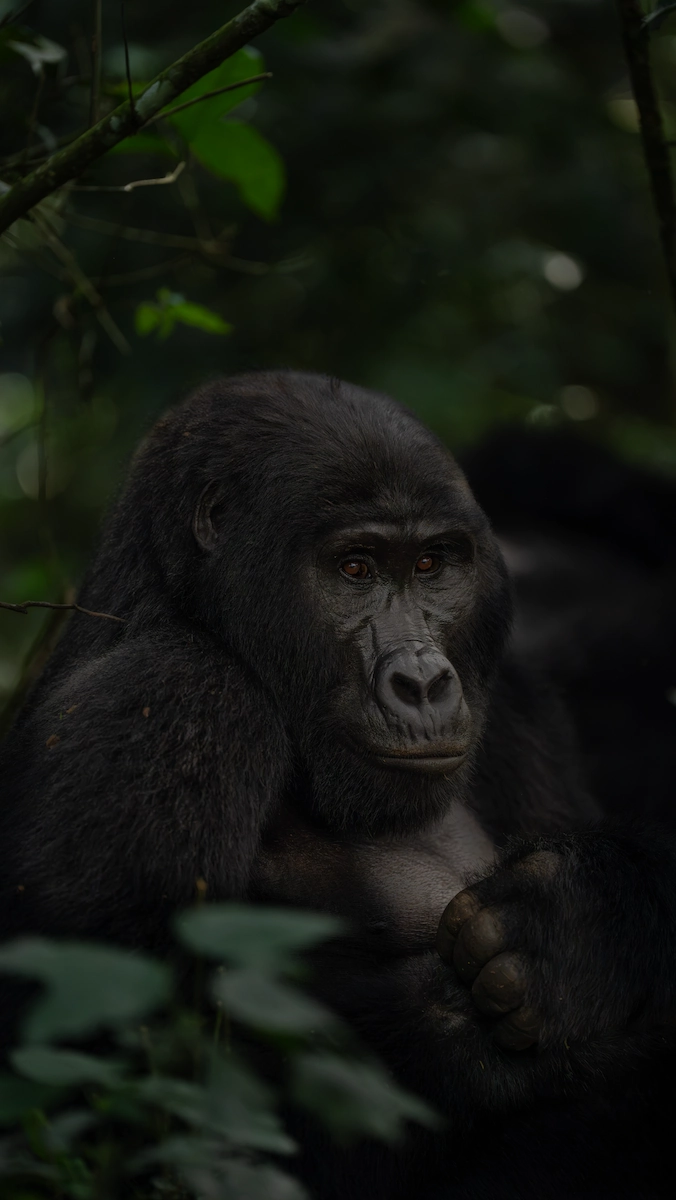
An honest view at human-wildlife coexistence
As is the case pretty much everywhere in the world, in East Africa space is key for wildlife to not just survive, but thrive. As Dian Fossey wrote in her 1983 memoir and scientific chronicle, Gorillas in the Mist: “Conservation of any endangered species must begin with stringent efforts to protect its natural habitat by the enforcement of rigid legislation against human encroachment into parks and other game sanctuaries.”
Whilst Fossey’s opinions on the relationship between animal and human inhabitants of the same area can be seen as controversial, it is widely recognized that her work and life’s mission is one of the main reasons we get to see mountain gorillas and other primates in their wild habitats today. Much like Jane Goodall in Gombe, Tanzania, Dian Fossey pioneered the habituation of these Great Apes and advocated for their sentience and protection until her death.
Before our gorilla trek in Rwanda’s Volcanoes National Park, we visited the Ellen DeGeneres Campus of the Dian Fossey Gorilla Fund in Kinigi. Should you choose to visit the mountain gorillas in Volcanoes National Park, the centre offers amazing context to the history of the region in an impressively elevated setting.
A primate safari in Uganda and Rwanda: an experience unlike any other
A primate safari in Uganda and Rwanda is nothing like the classic safari experience you imagine. No twice daily game drives in a fenced game reserve, where the only other living beings you encounter are lodge staff and wildlife. Instead, expect local communities living side by side - and sometimes amongst - the wildlife in national parks. Your lodges’ access roads wind between family homes, farms and plantations - some on hills so steep you cannot imagine tilling the fields by hand. And yet, that is exactly what the people living here do, and have done, for decades.
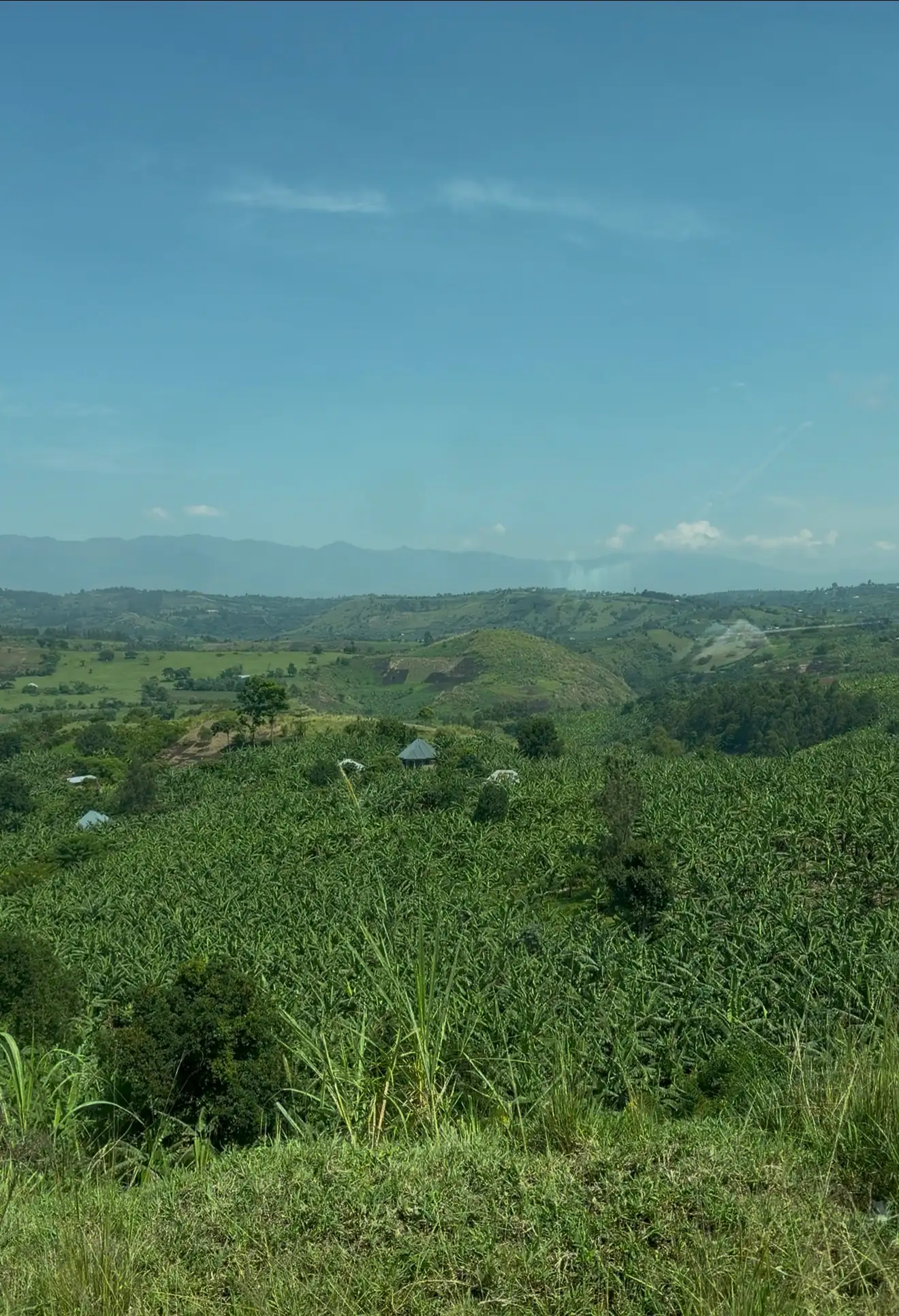
No fortress conservation here. Some say it's part of the charm and promise of East Africa. Others are disappointed that their idealistic “untouched wilderness” expectation isn’t fulfilled. If you ask me, after almost a decade of working mainly in the southern African safari and conservation industry, it is a little bit of both, but definitely more of the former.
Many places you visit on safari - no matter where in Africa - give the illusion of being untouched. Yet if you look just a little bit deeper, you realize that even despite electric fences separating National Park from human settlements, the issues are still one and the same: competition for space, poverty driving criminality and wildlife constantly trying to adjust to a growing human population. It’s just less obvious to visitors in some places, compared to others.
Yet in many places, there is beauty to be found in the coexistence between people and wildlife. And when done right, the very proximity and familiarity of people living harmoniously with wildlife offers glimpses of hope for the future: a passion and willingness to protect, conserve and expand wild spaces out of a deep appreciation of their value for both humans and wildlife.
It is this passion that I saw most during our 10-day trip with Volcanoes Safaris. And it’s the same passion that propels my motivation to show up time and time again for what we do at Wild Wonderful World Safaris: creating bespoke, considered journeys for discerning travelers who want their safari to matter.
In this blog, I give two practical examples of encounters that made me reflect on human-wildlife conflict and coexistence, the differences between the South African and East African conservation models, and how even in these different contexts, the challenges and balance between conservation and safari tourism are fluid and ever-evolving. And so should our solutions be.
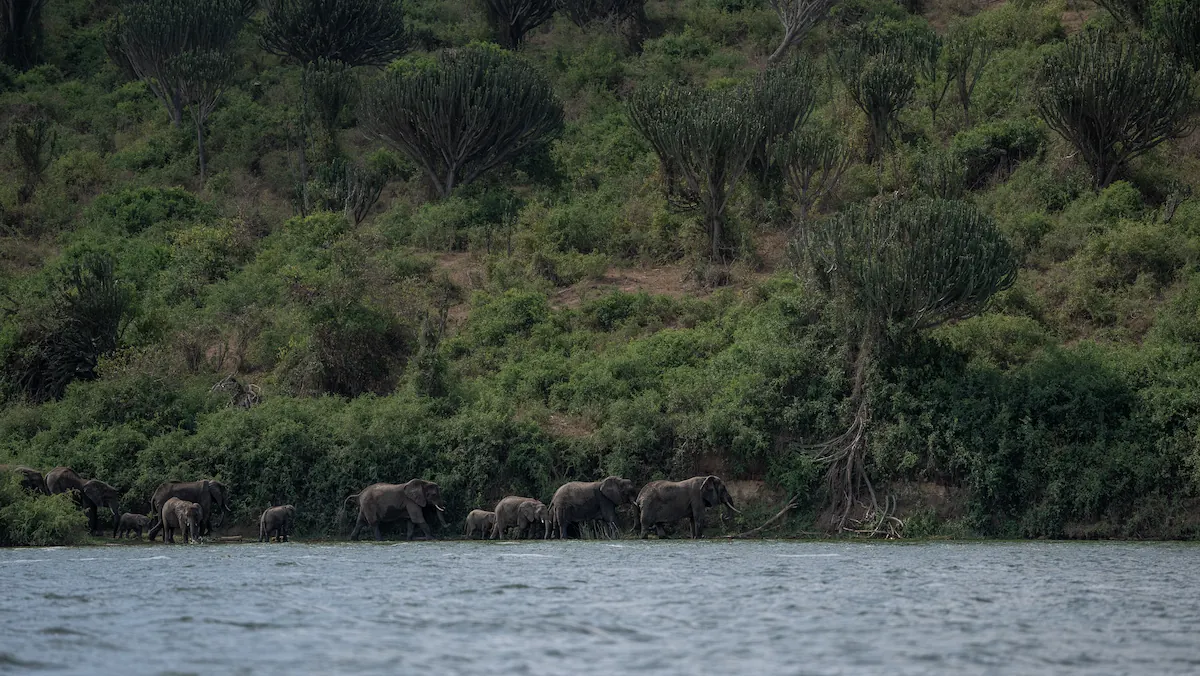
The Kazinga Channel: a view into human-wildlife coexistence on the edge
Queen Elizabeth National Park is in many ways a great source of national pride for Uganda. It is a massive drawcard for international tourism. At the same time, the almost 200,000ha UNESCO Man and Biosphere Reserve in western Uganda is both a conservation success and an unresolved colonial legacy.
The 11 “enclave” towns inside Queen Elizabeth are mostly inhabited by Basongora people. Historically, the original inhabitants of this landscape were pastoralists. When the park was established by British colonial authorities in 1952 - despite the Tooro Kingdom council’s rejection - the Basongora were forcibly resettled, barred from grazing their herds outside of small areas. Instead, they were forced to change their main livelihoods to fishing - an easily taxable trade.
This created a situation where you have local communities living inside the national park boundaries. The main income of their 60,000 inhabitants is sourced primarily from the local water bodies, primarily from fishing (in Lake George, Lake Edward, and the Kazinga Channel), the salt trade at Lake Katwe, keeping livestock (cattle, goats, sheep), and small-scale crop cultivation. No fences separate the villages from the protected areas (and the wildlife) and municipal services are almost non-existent.
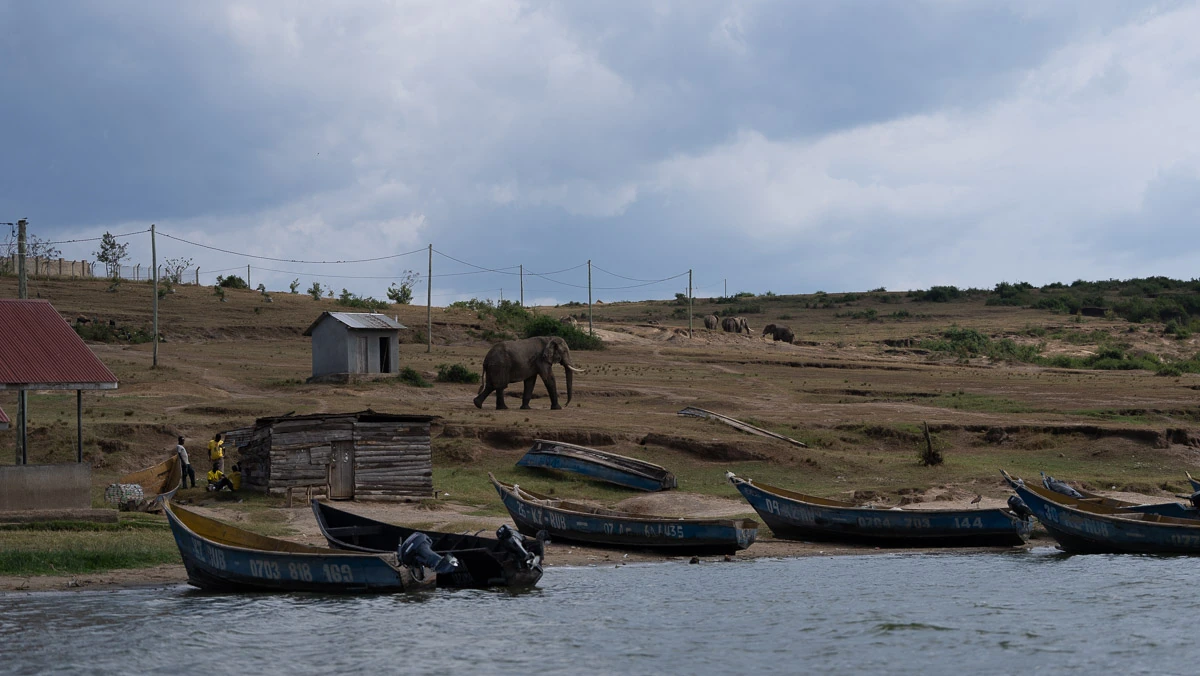
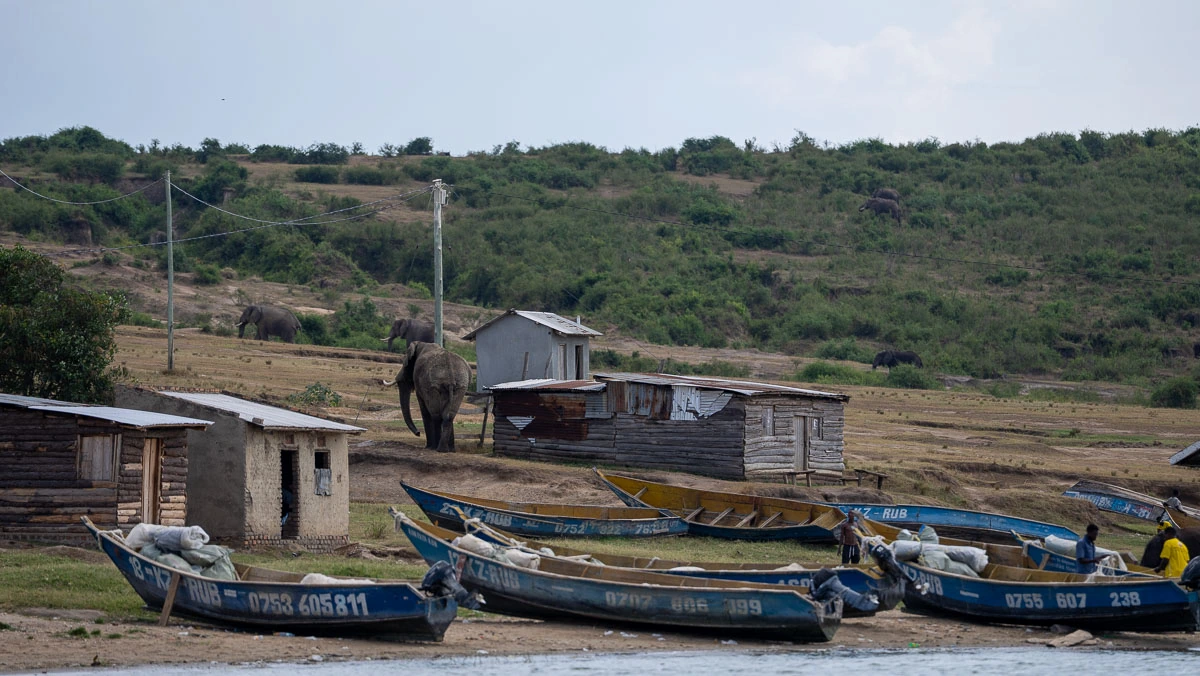
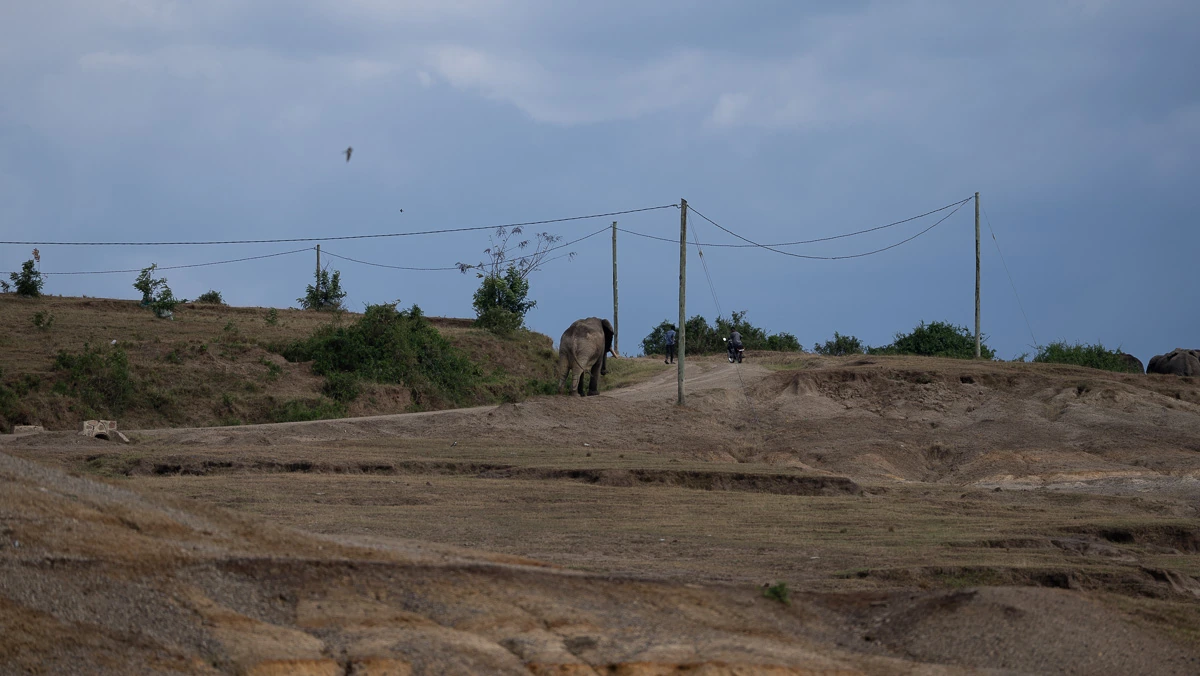
As a South African, it will always be a bit foreign to see communities living in the middle of protected areas. So when we passed one of these fishing villages during our Kazinga Channel boat cruise, it was a shock. We arent't used to seeing wildlife and locals in such close proximity, so it was perturbing seeing buffalo standing between the boats, and watching a bachelor herd of bull elephants meander up the village road, right past children, goats and motorbikes. The barely existing formal municipal waste collection means that we saw lots of plastic pollution, litter and rubbish along the shoreline of the channel.
While the enclaves are part and parcel of how QENP operates today, the pollution detracted from our idealised view of pristine wilderness. Many photos I took of wildlife along the shore have plastic bottles in them. This may sound like the world's smallest violin playing just for me, but it’s a symptom of a much larger issue in wildlife conservation: whose wellbeing comes first, the people’s or the animals’, and why can’t it be both?
During our visit to Rwenzori Founders, our guide David had told us how the first King of Buganda strategically used the totemic system as an ingenious socio-ecological framework to build a united kingdom and safeguard a rapidly declining wildlife population. Totems are highly revered natural symbols (typically animals, birds, or plants) that represent a clan's shared ancestry, heritage, and identity. Kabaka Kintu installed the "Taboo" Hunting Ban: a decree strictly forbidding for any clan member to hunt, kill, cook, or eat their own totem animal. Instead, they were to protect and revere their totem animal.
Because a clan only abstained from killing its specific totem, they could still hunt other animals for food. However, because the target species changed from clan to clan, no single animal population was over-hunted, giving all wildlife species a balanced opportunity to multiply and thrive. This totemic culture is still very much part and parcel of Ugandan society today, and perhaps could again be a bridge between increasingly diverging views on human-wildlife coexistence.
Chimpanzee vs Gorilla trekking and Ugandan vs Rwandan gorilla trekking: what is the difference?
There’s something to be said for sharing over 98% of DNA with the Great Apes of Africa. In fact, humans share a higher percentage of DNA with gorillas and chimpanzees directly, than gorillas and chimpanzees share between each other.
To me, it is therefore the most natural thing to want to encounter these Great Apes in the wild, face-to-face. As well as wanting to know how these encounters compare, both between species and between groups in different regions and countries.
To know more about the differences between our gorilla treks, click here. To read my experience with chimpanzees, click here. And to learn more about our trip as a whole click here.
Right off the bat, here is the biggest difference for me between our two chimpanzee encounters and two gorilla treks: I did not once feel uncomfortable with the chimps, whereas during both gorilla experiences I wasn’t able to fully relax. Of course, these were only four instances - two chimpanzee treks and two gorilla treks. The situation could have been a lot different if we had encountered different families, at different times or on different days.
The chimps accepted us, the gorillas simply seemed annoyed
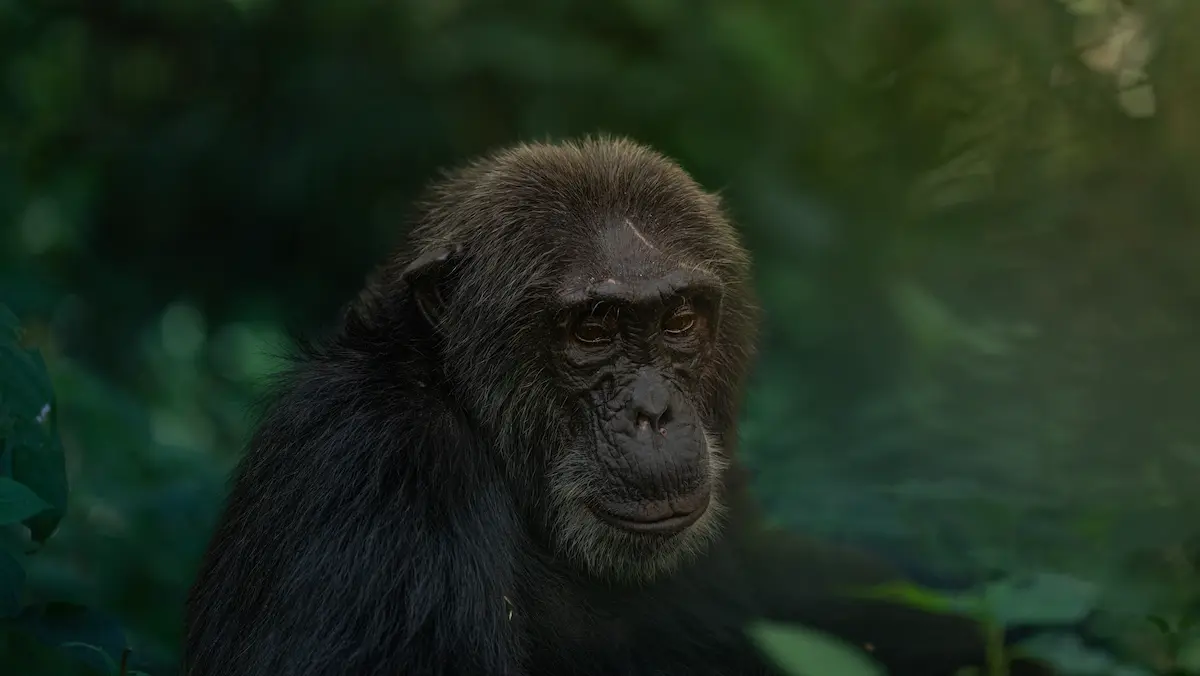
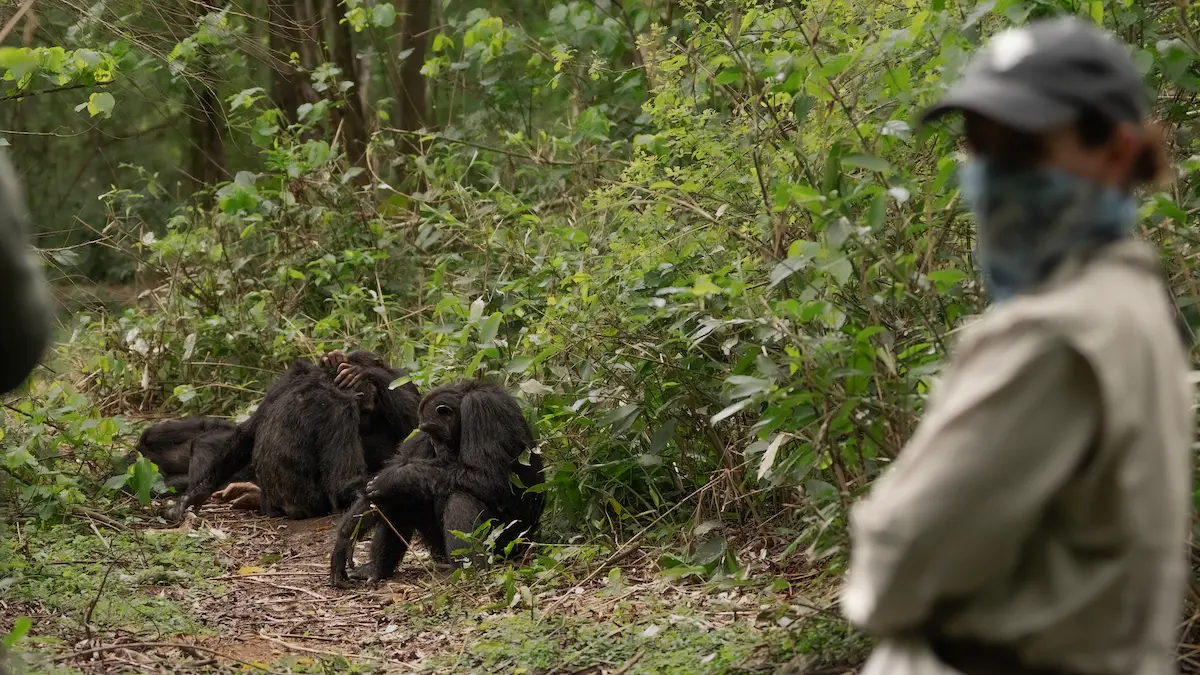
Overall, amongst the chimps, I felt less like an intruder. For them, we seemed to be part of the forest, the landscape. Any time they wanted to move, and we happened to be in their path, the chimpanzees would simply walk past us. Not pushy, but not scared or overly bothered either. When moving from resting to feeding, they would get going slowly, giving you clear indications of when and where they wanted to go. I could read their behaviour and intention, and they courteously and patiently gave me time to decipher their intended direction.
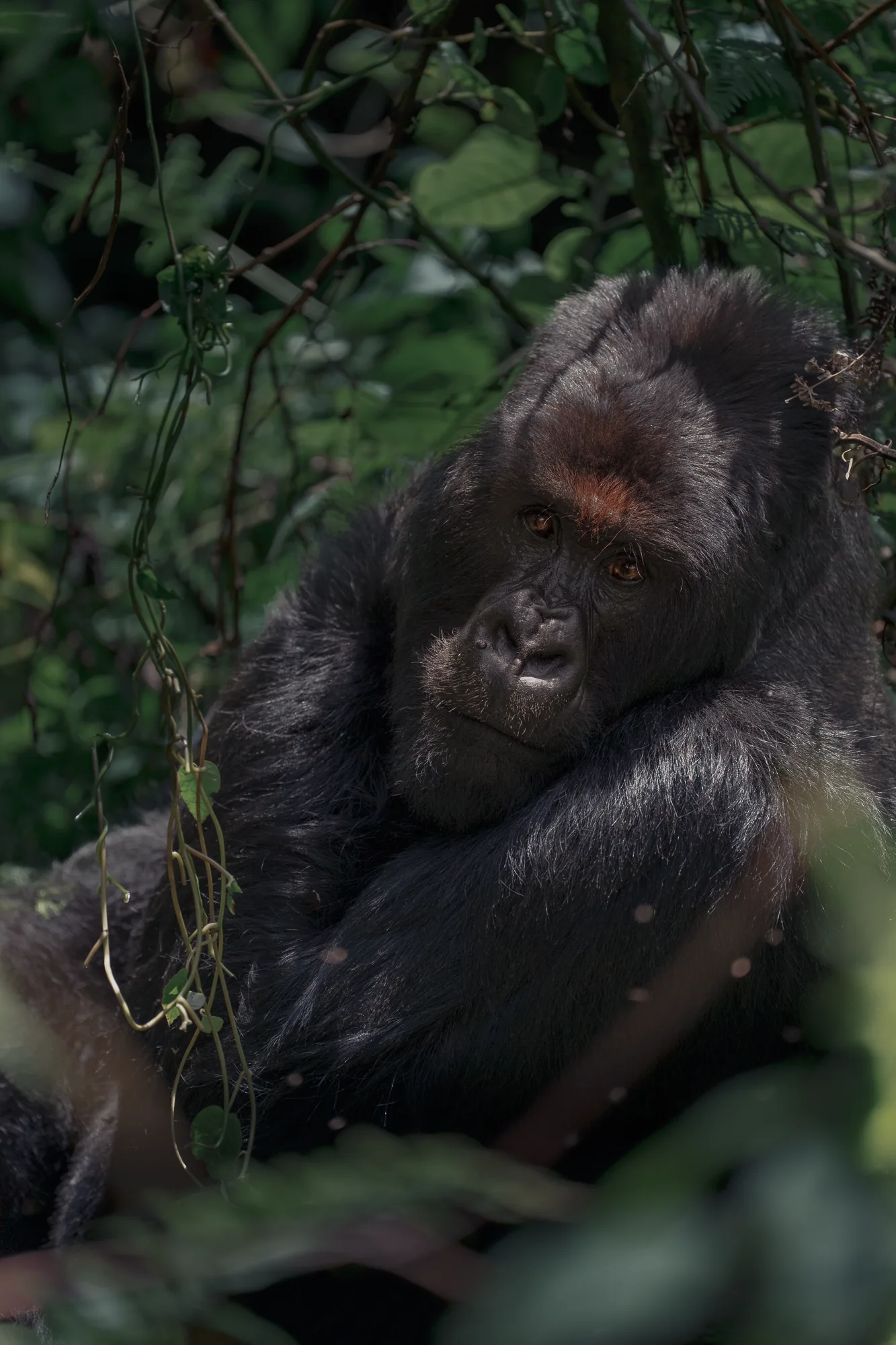
The gorillas, on the other hand, were much less predictable. They would be feeding or resting one second, and up and moving the next. Straight towards you - and through you if you didn’t move. Which wasn’t always possible, given the steep, uneven terrain littered with roots, trees and shrubs. Or simply because there wasn’t even time to do so. As I said, the silverback during our first trek did not stop monitoring us, and on both occasions there were adults or subadult individuals within the group who were known as “stubborn” or “cheeky”.
It felt as though while the chimps exuded a sense of calm acceptance of us, the gorillas were simply annoyed by our presence and proximity. During both gorilla encounters on either side of the border, our “viewing window” was cut short of the allotted one hour because the “stubborn” individuals started physically interacting with us. And while we experienced equal proximity with both species - much closer than the prescribed 7-8m - the gorilla interactions on both occasions simply felt too close for comfort.
Balancing between close enough and too close: a tight line to walk
It is completely understandable that rangers and trackers try their best to let everyone have a chance to take nice pictures, without too much of the ever present vegetation in front of the gorillas' faces. Our guides were very good at alternating our positions to enable different views of the gorillas.
And yet I couldn’t shake the feeling that that shouldn’t have come before the comfort of the gorillas and their natural behaviour. Even as someone who was hoping for epic gorilla photos and with a passion for videoing wildlife, I didn’t enjoy what I could see was the start of a slippery slide into sensationalist wildlife viewing and intentional provocation of too-close encounters. It seems that this observation wasn't a one-off either: a peer-reviewed study in Bwindi found the distance rule was broken in almost every tourist visit it observed.
Yes, it is hard to maintain the prescribed distance from a wild animal with agency, on foot and in thick vegetation on steep slopes and uneven terrain. Even still, that is what you should be able to expect from guides who undergo extremely rigorous training and selection processes.
At the danger of being cliché, another quote from Dian Fossey’s Gorillas in the Mist comes to mind: “Any observer is an intruder in the domain of a wild animal and must remember that the rights of that animal supersede human interests. An observer must also keep in mind that an animal's memories of one day's contact might well be reflected in the following day's behavior.”
And from how I experienced our gorilla encounters, the art of balancing the desire of wildlife to be left alone, with the human concept of safari and tourism as a way to protect wildlife, seems to be as delicate today, as it was during Dian Fossey’s lifetime.
The most unexpected: the smallest primate gave us the hardest time!
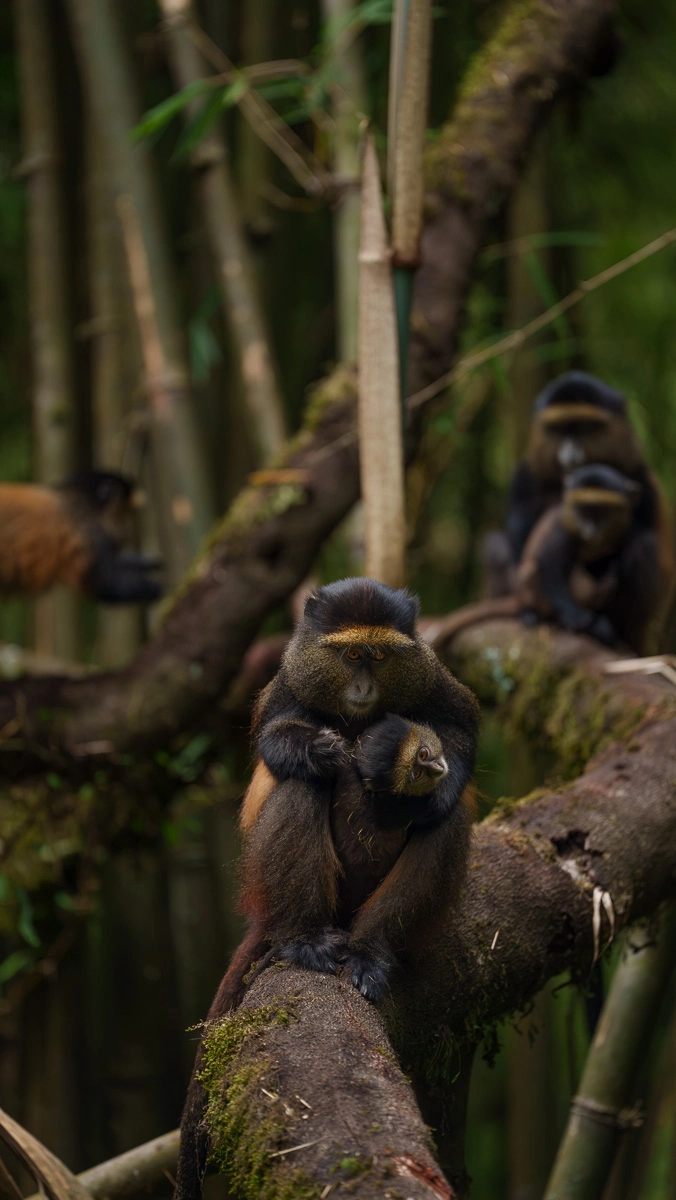
While a golden monkey is on average more than 15 times smaller than a mountain gorilla, the trek to reach them in Mgahinga Gorilla National Park was proportionally harder. Safe to say, we had all underestimated the effort it would take to reach these playful little monkeys.
One recommendation: hire a porter! This hike was by far the most challenging of our five primate treks. And seeing as I had already hit a personal walking workout record during our gorilla trek in Bwindi the previous day, you can imagine just how challenging these tiny primates were to reach.
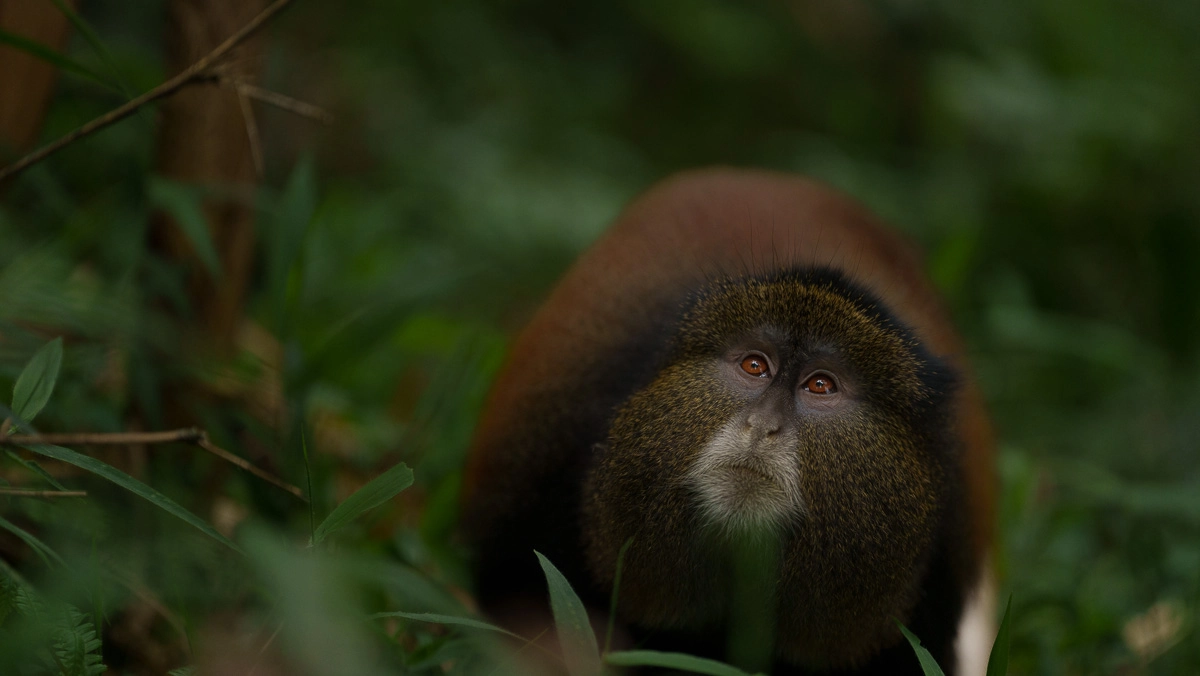
The forest though, was by far the fairest of them all. Perhaps even more so than the one in Kyambura Gorge. The montane forest of Mgahinga Gorilla National Park is truly stunning. Massive trees laden with moss and ferns, vines swung artfully between them, trailing over gentle grassy slopes, and expansive views of the neighbouring volcanoes. It really felt like an enchanted forest.
But the hike from HQ is long, and the collective relief you feel when you finally reach the bamboo forest is palpable. If you want to see golden monkeys without the effort, you’re better off booking your trek in Rwanda.
Watching these little primates is a lot of fun! As you enter the bamboo forest, all of a sudden, you are surrounded by golden monkeys of all ages and sizes. The confident alpha male struts past, only a few meters away, whilst two youngsters chase each other on a massive fallen over log. A baby tries its very best to escape mom’s grooming attempts, and all the while you are standing amongst tall, towering bamboo stalks, narrowly avoiding being hit on the head with a discarded piece of bamboo from the monkey feeding right above you.
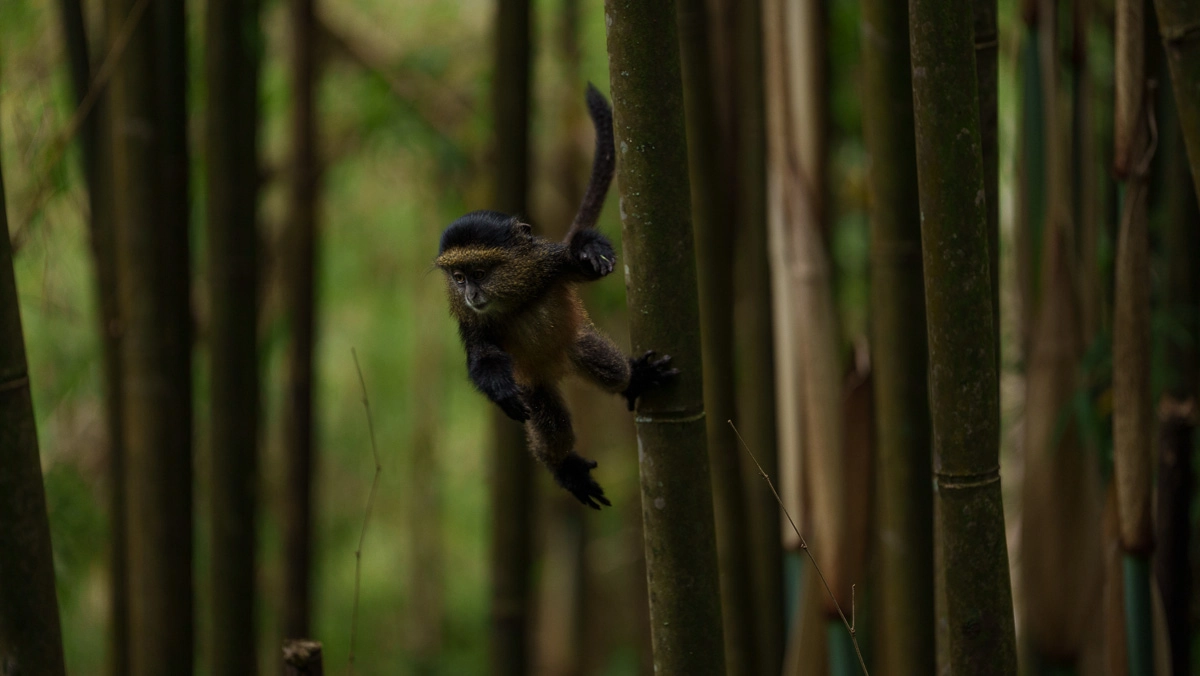
If you are lucky (or from the local perspective at least, unlucky), you can avoid the literal golden showers too! The chaos is real and it’s hard to know where to look with so much action going on all around you. Least of all, right above your head. Talking about showers, we must have hit a serious stroke of luck because on not one of our five primate treks, did we have even a drop of rain! And we were here at the start of the rainy season too.
While the small primates are endearing and entertaining to watch, a golden monkey trek in Mgahinga is very much a typical case of enjoying the journey as much as the destination. Something that is just as true about our entire safari in Uganda!
Key Takeaways
- A primate safari in Uganda and Rwanda is nothing like a classic southern African safari. There are no fenced reserves or twice-daily game drives. Communities live alongside, and sometimes inside, the parks, and your lodge access roads run past family homes and farms.
- The conservation challenges in East and southern Africa are the same: competition for space, poverty and a growing human population. Electric fences in South Africa make these pressures less visible to visitors of protected areas, whereas in Uganda especially the lines between human settlement and protected areas are much more blurred.
- The regions surrounding national parks in Uganda and Rwanda are different. In Uganda, the boundaries are often gradual and porous, and Queen Elizabeth National Park has 11 fishing enclaves inside it. In Rwanda, a volcanic stone wall forms a hard line between farmland and Volcanoes National Park. This is still much more permeable than the electric fences we are used to in South Africa.
- Seeing elephants walk through a fishing village on the Kazinga Channel, past children and motorbikes, showed both the reality of coexistence and its cost. Plastic pollution along the shoreline was another visible consequence of the enclave system in QENP.
- The main difference between our four great ape treks for me, was that I never felt fully relaxed with the gorillas, whereas during the chimpanzee interactions I felt much more at ease. The chimps moved predictably and walked calmly around us. The gorillas changed from resting to moving in seconds, often walking or running straight through our group.
- Both gorilla encounters were cut short because individual gorillas began physically interacting with us. We were placed much closer than the official minimum distance, and rangers constantly cleared vegetation to give every guest a good photo opportunity. While appreciated, this did risk putting human interests ahead of the gorillas’ comfort.
- The golden monkey trek in Mgahinga was the hardest of our five primate treks, but we were rewarded with to most beautiful montane forest. If you want to see golden monkeys with less effort, trek them in Rwanda instead.
FAQ about Primate Trekking and Conservation in Uganda and Rwanda
What is the difference between chimpanzee and gorilla trekking?
In general, chimpanzee viewing is faster and more active, while gorillas move slower but can get physically closer. Chimpanzees are known to move quickly through the tree tops and on the ground when they are not resting. Gorillas spend more time feeding and resting in thick vegetation, so you usually stay in one area. In our experience though, the chimpanzees were easier to read and calmer around us, while the gorillas were less predictable.
Should I do chimpanzee trekking, gorilla trekking, or both?
If you have the time and budget, we highly recommend that you plan both, because the experiences are very different. Gorilla permits cost considerably more, from USD800 in Uganda to USD1,500 in Rwanda, compared with USD300 for chimpanzees in Kibale. The minimum age is also different: 12 for chimpanzees and 15 for gorillas, so families with younger children can only do chimpanzee treks. Uganda is the only one of the two countries where you can trek both chimpanzees and mountain gorillas in a single itinerary without crossing a border.
Is gorilla trekking safe?
Yes, gorilla trekking is safe when you follow your guides’ instructions. Serious incidents involving visitors are extremely rare. Gorillas do push, charge or grab visitors at close range, which happened during both of our treks, but these are usually warnings rather than attacks. The bigger risk is to the gorillas, which are highly vulnerable to human respiratory diseases. Masks are mandatory and if you are ill on the day of your trek, you will not be allowed to go.
How close do you get to gorillas and chimpanzees?
The rules require you to keep a minimum distance of 7-8m from the apes, but in practice visitors are often much closer. On all four of our great ape treks we were within a few metres. A peer-reviewed study in Bwindi found the distance rule was broken in almost every tourist visit it observed. The rule exists mainly to protect the apes from human diseases. If you would prefer more distance, say so to your guide during the briefing.
Do people live inside national parks in Uganda?
Yes, in some parks. Queen Elizabeth National Park has 11 fishing enclaves inside its boundaries, home to communities who were living there or resettled there when the park was created in 1952. There are no fences between the villages and the wildlife, so elephants, buffalo and hippos regularly move through them. This is very different from the fenced parks of South Africa.
How is conservation in East Africa different from South Africa?
The main difference that you notice as a visitor, is how parks are separated from people. Most of South Africa’s reserves are fenced, which keeps wildlife and communities apart. In Uganda, park boundaries are often open, and communities live alongside or inside protected areas. Rwanda’s Volcanoes National Park has a stone wall marking the boundary between national park and farmlands. The underlying pressures, competition for land, poverty and population growth, are the same everywhere. To me, they were simply more visible in East Africa.
Can you visit the Dian Fossey Gorilla Fund in Rwanda?
Yes. The Dian Fossey Gorilla Fund’s Ellen DeGeneres Campus is in Kinigi, close to the Volcanoes National Park headquarters. It includes exhibits on the history of gorilla research and conservation, artefacts from Fossey’s time, and a replica of her cabin at Karisoke. We visited before our gorilla trek in Rwanda, and it gave great context for our trek.
Where can you see golden monkeys, and is the trek difficult?
You can trek golden monkeys in Mgahinga Gorilla National Park in Uganda and in Volcanoes National Park in Rwanda. In Mgahinga, the trek to the bamboo forest where the monkeys live is long and steep, and it was the hardest of our five primate treks. The trek in Rwanda is generally shorter and easier. Hire a porter in Mgahinga, and expect a lot of activity once you find the group, with monkeys feeding and playing all around you.
What are clan totems in Uganda, and how do they relate to conservation?
In Buganda tradition, each clan has a totem, usually an animal or plant, that members must not hunt, kill or eat. Our guide explained that because each clan protected a different species, no single animal was over-hunted. The totem system is still part of Ugandan identity today, and could still be a cultural bridge for modern conservation.
Does primate tourism protect gorillas and chimpanzees?
Yes, but it has to be managed carefully. Permit fees fund park protection and anti-poaching, and part of tourism revenue goes to the communities living next to the parks, giving them an economic reason to protect the apes. Guides, rangers, trackers and porters benefit from the treks directly through salaries.
The communities around the reserves benefit from tourism through the crafting and selling of keepsakes, employment in the lodges and from goodwill from visitors and non-profit organisations. Lodges often have programs geared towards distributing tourism income in nearby communities. When you book through Wild Wonderful World, 20% of proceeds from your safari also goes directly into our conservation fund.
Tourism income also supports various conservation and research programs that directly protect the wildlife. The main risk from tourism is pressure for close encounters and photographs, which increases disease transmission and stress for the animals.
Planning a primate safari in Uganda and Rwanda? Get in touch with our travel desk to custom-design your ideal safari.
Written by Evelyn Poole, safari marketing specialist and conservation fund director at Wild Wonderful World