The Southern Ground Hornbill is a keystone species that contributes to ecological succession processes. Because of their large spatial requirements, any successful conservation action has ripple effect on all other savanna and grassland species.
The APNR Southern Ground Hornbill Project works to maintain and expand the habitat of Southern Ground Hornbills on the Western border of the Kruger National Park. Husband and wife, Kyle and Carrie are the researchers making up the APNR Ground Hornbill team and as the name suggests, their research covers the entirety of the Associated Private Nature Reserves (197,885 hectares) that border the Kruger National Park.
From the 2023/2024 breeding season, the team observed that none of the 10 juveniles survived through the year, a worrying outcome. Upon reviewing the data over several years, the research team identified a correlation between higher temperatures (during the nestling period and during winter once nestlings have fledged) and reduced overwinter survival.
These findings, the chick weighing and nests checks we have been sponsoring and more form part of Carrie Hickman’s PhD thesis - which is to be completed by the end of 2025. Her findings raise important concerns about the impacts of rising temperatures on juvenile survival rates and add to our understanding of the species’ survival.
It has been a really good breeding season so far. Currently, 11 groups are breeding which is a very good number at this point in the season! The team anticipates that potentially four, maybe five, or even more might still breed, making it look like it's going to be a very good breeding year. Sadly, one breeding group has already failed because the female was taken by a leopard. This is very unfortunate as this group is unlikely to breed again for the next few years due to the predator pressure. This is a natural occurrence.
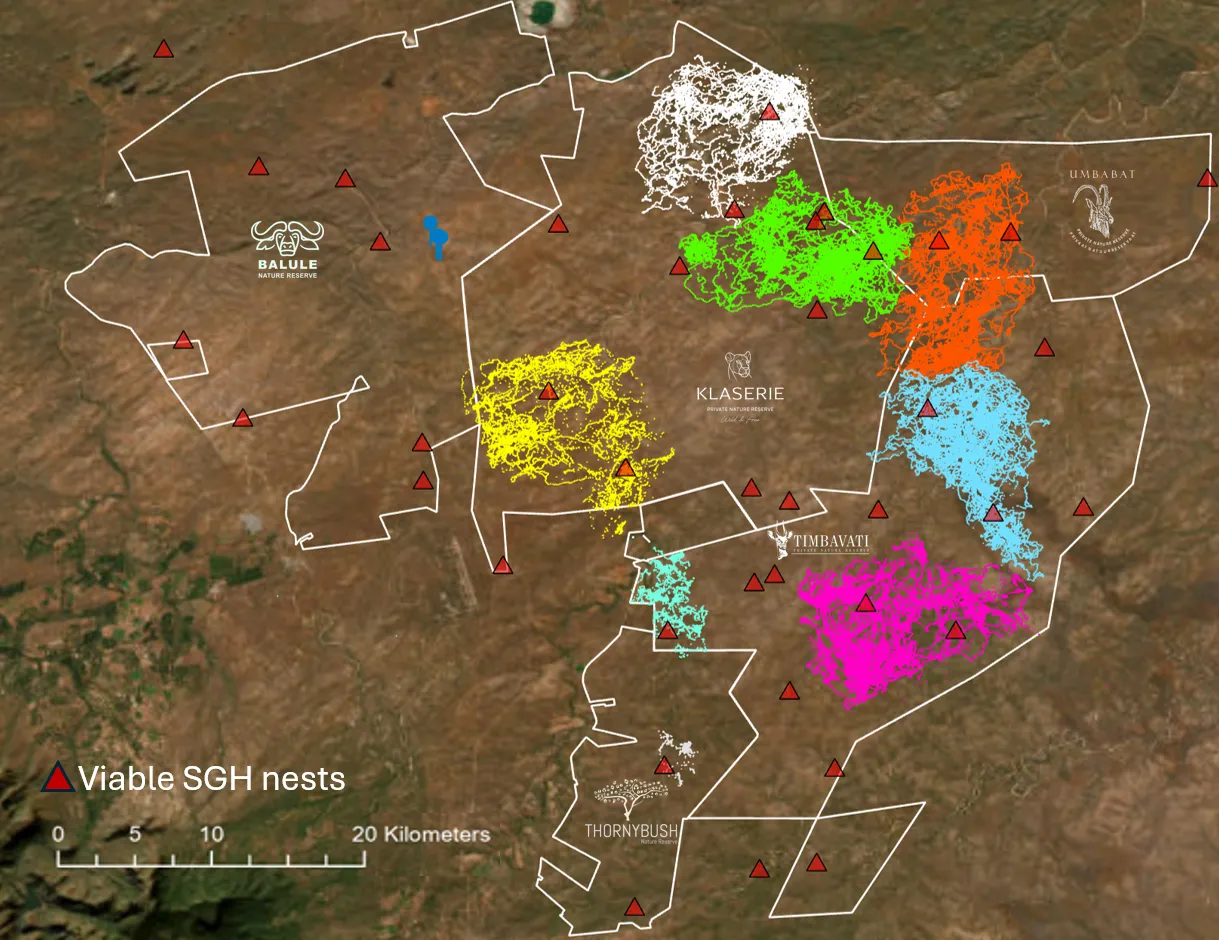
Despite a serious ankle injury in August hindering field work, Kyle's post doc using tracking data has been advancing well. His research centres around identifying the factors that influence Southern Ground Hornbill territories. Ground Hornbills live in family groups and are territorial - meaning that they remain within a certain area and defend said territory against other groups. The aim is to better understand the birds’ movements, behaviour and habitat use, in order to further expand their habitat and increase survival rates of this endangered species.
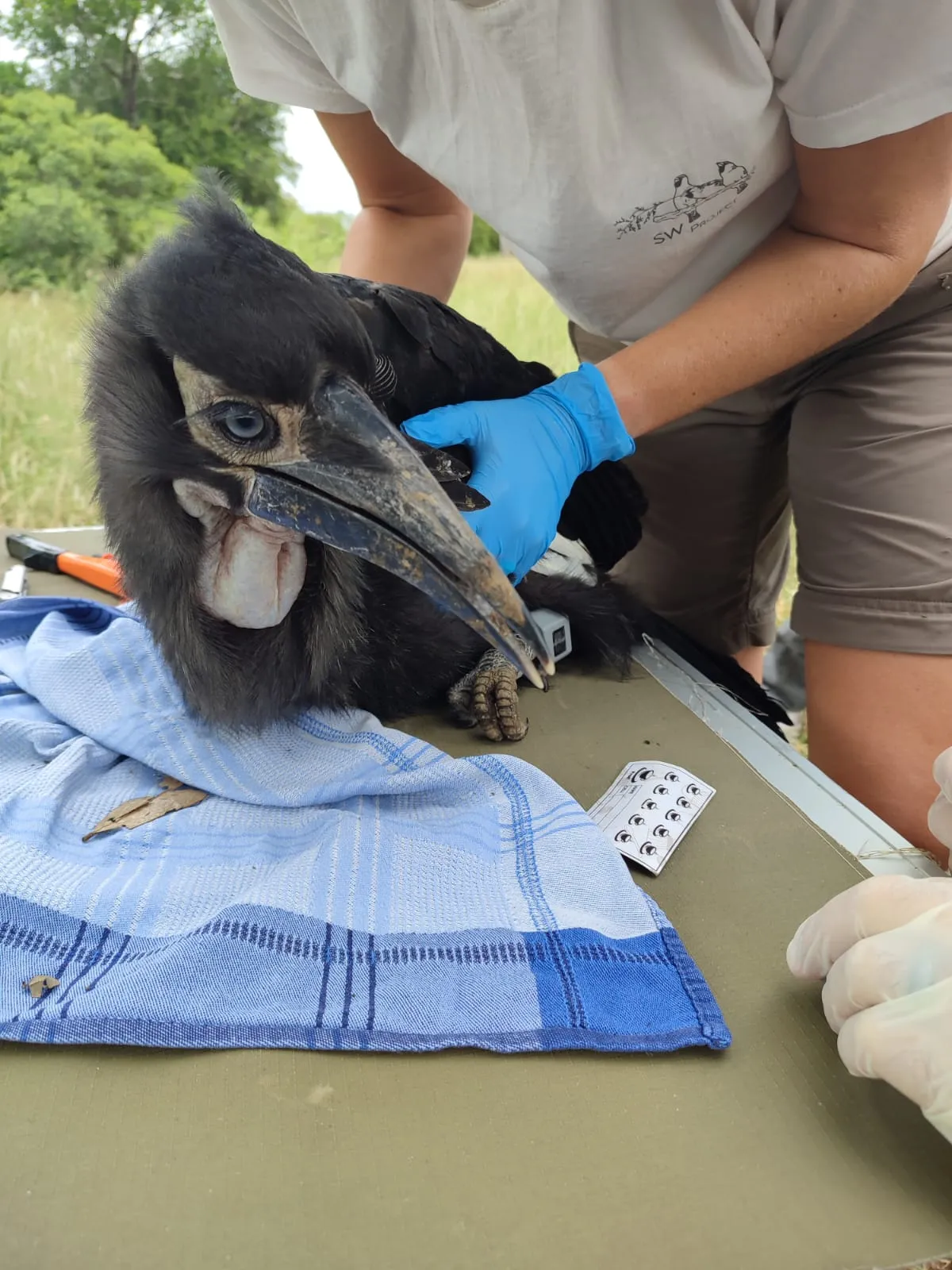
The tracking devices continue to prove massively successful. During 2024, the team worked hard on developing these trackers through several prototypes. This study is the first ever time these types of tracker have been deployed on Southern Ground Hornbills. The trackers are fitted into rings, which are then fitted onto the chicks' legs right before they are due to leave the nest. The tracker stores GPS data points, which are then offloaded via receivers that are set up in the field and update three times a day when a bird comes within contact range. The team then downloads that data and maps it in order to determine the territory size, boundaries and use.
The first tracker was fitted onto a chick in March 2025. This chick subsequently fledged the nest 15 March 2025. Since then, a total of 9 trackers were deployed. Of these, 6 birds are currently still transmitting data regularly, although the team suspects that there may be an additional one that is currently in KNP and thus out of range of the receivers installed in the APNR.
They are currently sitting at 200,000 locations recorded - covering a total area of 656 km2. This is an amazing start for Kyle’s post doc. Due to the good breeding season (currently 11 groups are breeding) and the fact that groups are breeding in different areas of the reserves, the number of data points collected from 2026 fledglings is expected to increase drastically. More tracking information will provide data on where different groups are, where they are not occurring, and why.
The team has ordered and installed the nest scales. Despite some teething issues (including the devices breaking because the birds are so destructive), they achieved a massive success: the team managed to get the first ever weight recorded of a wild ground hornbill. This is a huge success that will allow them to hopefully begin tracking the birds' body condition throughout the year. While the scales breaking may seem like a failure, this is an incredibly promising achievement from a research perspective. Tracking body weights like this helps researchers and conservationists keep track of the species' health. Because of the birds’ destructive nature, the next challenge is to figure out how to make the devices stronger!
The team also installed the first internal nest camera. They used an older camera for this, but they will be installing newer, wide-angle camera next to get a full view of the inside. I personally can’t wait for the hilarious footage we’re certain to get. But more importantly, having a view of the birds’ and chicks’ behaviour inside of the nests will be so valuable from a research perspective!
Wild Wonderful World has been generating funding for Kyle and Carrie to be able to continue their ground breaking research and conservation work since 2018 was and we are proud to still support them today. In 2025, we were able to raise $16,500 for the 2025-2026 breeding season. The team continues to work hard to generate additional funding to continue their success in expanding the birds’ habitat.
In 2024-2025, Wild Wonderful Word has contributed a total of ZAR740,000 or USD43,500 towards the project. This includes 19 tracking rings, 18 receivers, and 11 camera traps. Other expenses covered include salaries, assistant accommodation, fieldwork equipment, car repairs, ID rings, camera equipment, fundraising merchandise and DNA sampling.
Independently of our fundraising, we collect all donations on behalf of the project - 100% of all donations received is transferred in full. You can help by donating here.
Written by Evelyn Poole
.webp)